
The sign of the day
Everything that falls together today, and the silence where nothing does
What Nenemi is
«To walk», in Nahuatl. The door where the calendar's two counts are seen turning together, which is how it was lived: the solar year on one side, the 260-day count on the other.
It has four rooms: The sign of the day, the eighteen veintenas, the twenty trecenas and Ilhuitl, the ephemerides of the date.
The sign of the day
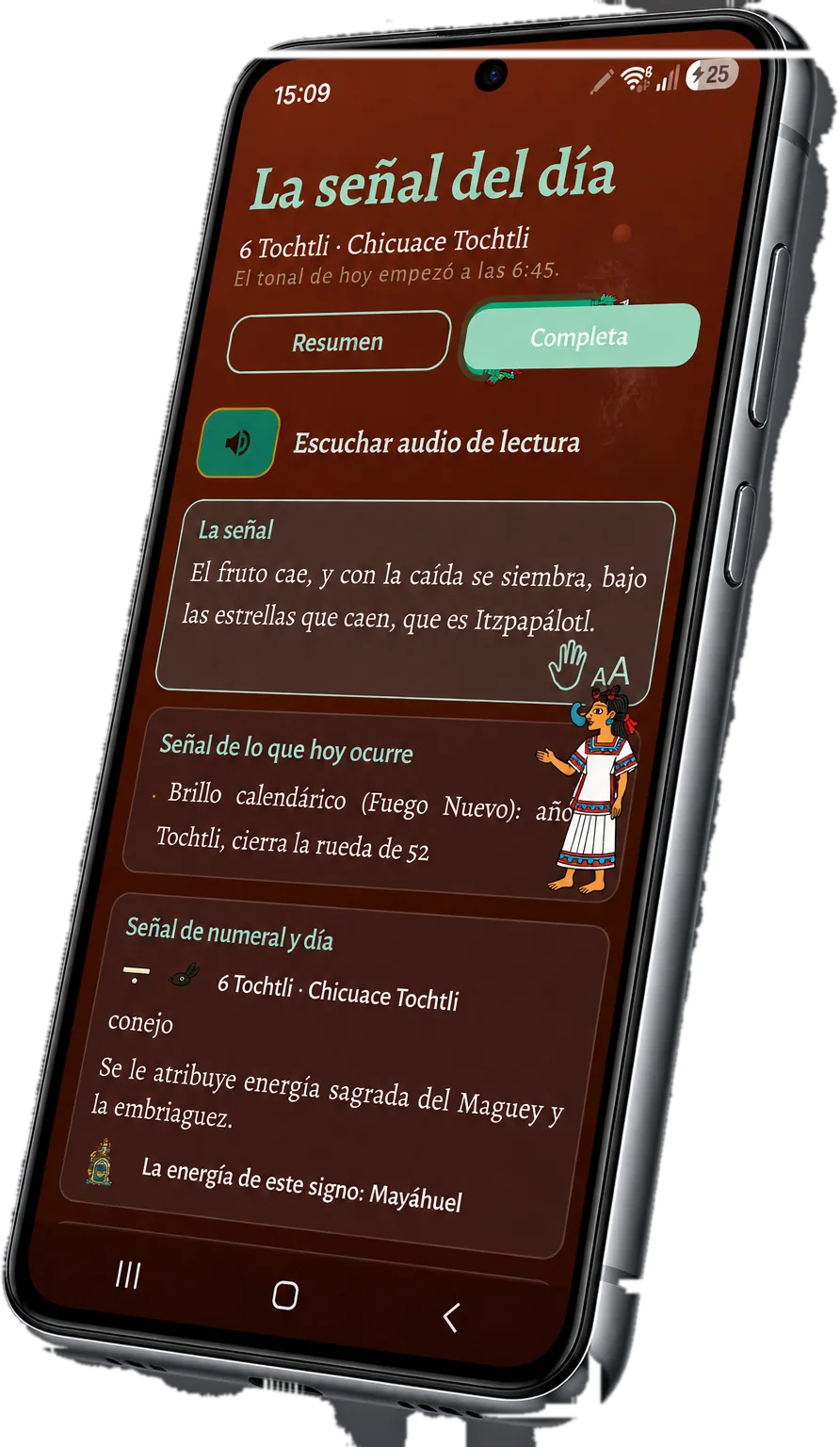
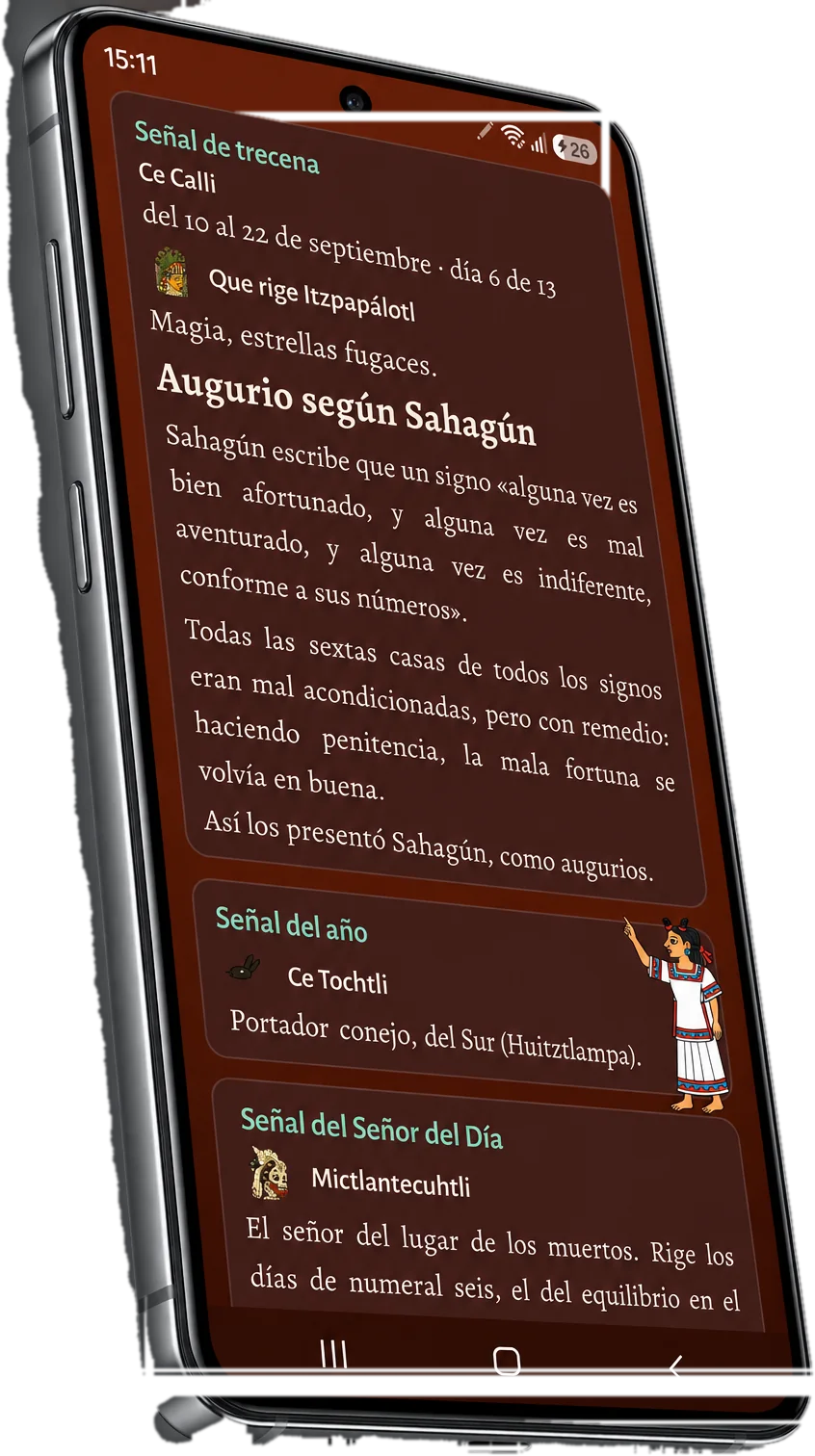
It gathers, for today, what each count contributes — each thing in its own module, with its frame and its title:
Sign of what happens today, with the marks that come out of the crossing. Sign of numeral and day, with what Sahagún says of that house of the numeral. Sign of the veintena, and which energy the sources dedicate it to. Sign of the trecena, and who rules it. Sign of the year, with its bearer. Sign of the Lord of the Day and of the Lord of the Night.
And the opposite day, which the count places half a turn from this one. It is arithmetic, not an interpretation — it is given as a datum, with no verbs to load it with meaning.
The rule that governs it, and makes it different
> If a condition is not met, the module does not appear.
That is the opposite of what a horoscope does, which always has something to tell you. Here there are days with seven signs and days with two, because that is what is in the sources.
Nine of the twenty trecenas carry an omen of the day; the other eleven do not. And the five nemontemi fall outside every veintena. Where the source is silent, the room is silent.
The silence is information. A day little is said about is a day little is known about, and that can be read too.
What never expires and what comes with the full version
The day's summary never expires. It is what the widget shows: which veintena you are in, which trecena and which year. The three data of position, the ones that place the day on both wheels.
The complete sign comes with the full version: the modules with what the sources say of that position, expandable and with their speaker.
The boundary is the project's own: the datum is reference and it is free; the apparatus of sources is the work.
It can be heard
Each module carries its speaker: the assistant narrates the whole sign of the day, with the voice composed on the device.
And there are two views of the same day — the summary, which is what the widget shows, and the whole sign — with the switch at the top.
Questions that reach this page
What is the sign of the day? What the sources say about today, gathered in modules: numeral, veintena, trecena, year and Lords. Each with its frame, and none when there is nothing to say.
What is Nenemi? «To walk», in Nahuatl: the door where the calendar's two counts are seen turning together. It has four rooms.
Why do some days show more than others? Because the sources do not say the same about all of them. Nine trecenas of twenty carry an omen of the day; the others do not. When a condition is not met, the module does not appear.
Is the sign of the day a horoscope? No, and the difference shows precisely in the silent days: a horoscope always has something to tell you. Here there are days with seven signs and days with two.
Which part is free? The day's summary, and it never expires: veintena, trecena and year. The complete sign — the modules with what the sources say — comes with the full version.
Twenty full days on installing. What is on the web and what is in the app.
How to cite this page
Alma Mexica, «The sign of the day», The app. Revised 2026-09-17. https://almamexica.org/en/app/senal-del-dia/