
Xochicuícatl
Five rooms to listen, breathe, keep vigil and sleep, with the music of the day
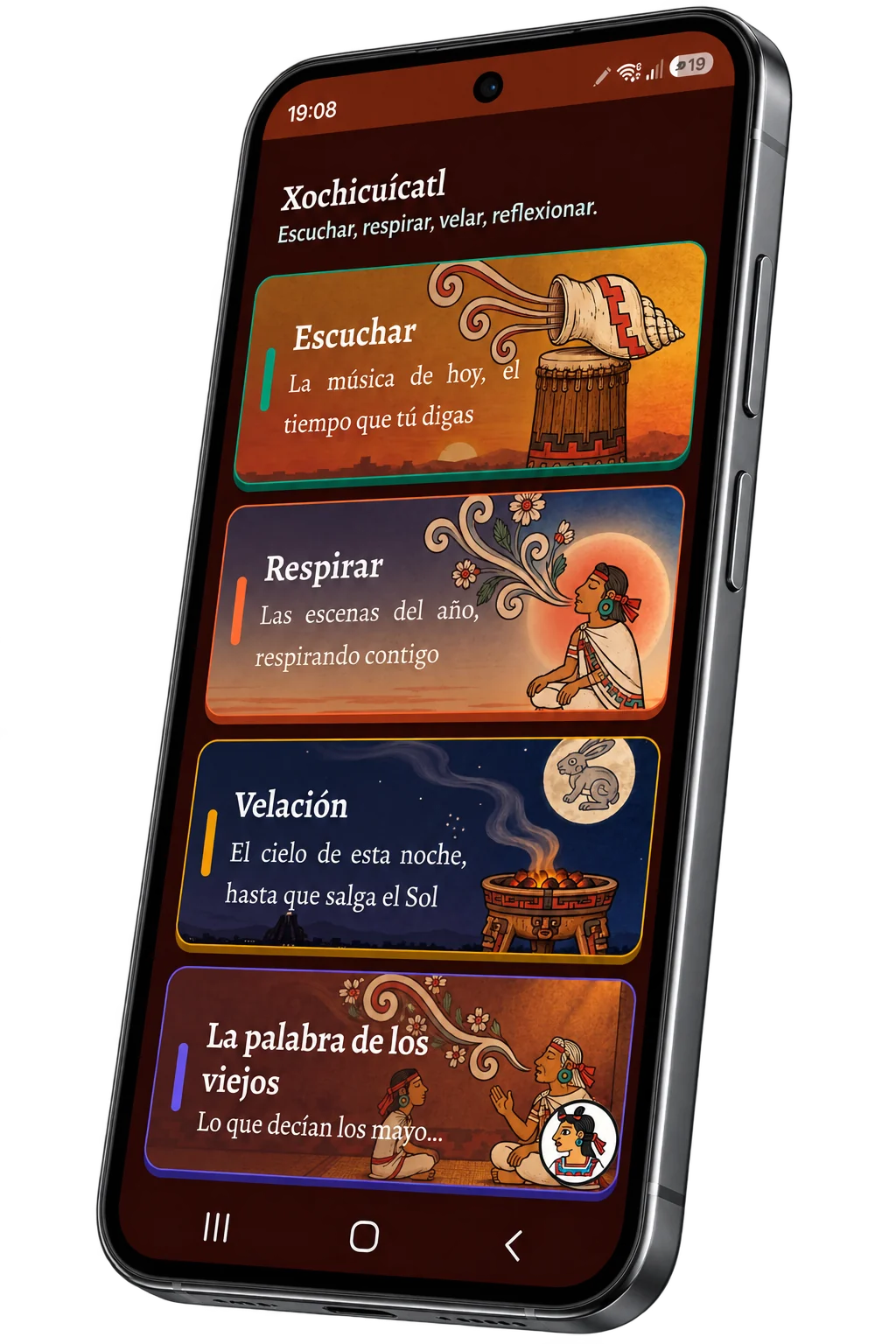
What this door is
Xochicuícatl is «flower and song» in Nahuatl: the name the Mexica gave to poetry. It is the part of Alma Mexica made for staying, not for consulting — for putting something on and remaining.
Five rooms, all around the same music: the piece each day is owed by its own numbers.
For sleeping, with a timer that runs to sunrise. For meditating, with the scenes of the year breathing along with you. For concentrating while you work or study. Or for keeping vigil through a whole night with the real sky over the Templo Mayor.
The five rooms, one by one
Listen. Today's piece, for as long as you say: a short while, half an hour, ninety minutes, or until the sun comes up. It is the sleep timer the rest apps have, with one difference — here what plays changes every day and never repeats.
And three characters, which are three ways for the same day to sound: reposo for stillness, reading, letting the afternoon run; enfoque for working or studying with something in the background that does not distract; sueño, the slowest pace, for the night.
Breathe. The eighteen scenes of the year, one per veintena, that move to the rhythm of your breathing. The image comes in and goes out with you. It is guided breathing with no countdown and no voice instructing: only an image that rises and falls, and music beside it.
Vigil. Tonight's sky over the Templo Mayor, with the planets where they actually are, until dawn. Made to be left on and fallen asleep to. It is not an animated background: it is the sky computed for that night and that place.
The word of the elders. The huehuetlahtolli — the speeches the elders addressed to the young — read aloud. They come from the Florentine Codex, Book VI, and each is cited by folio.
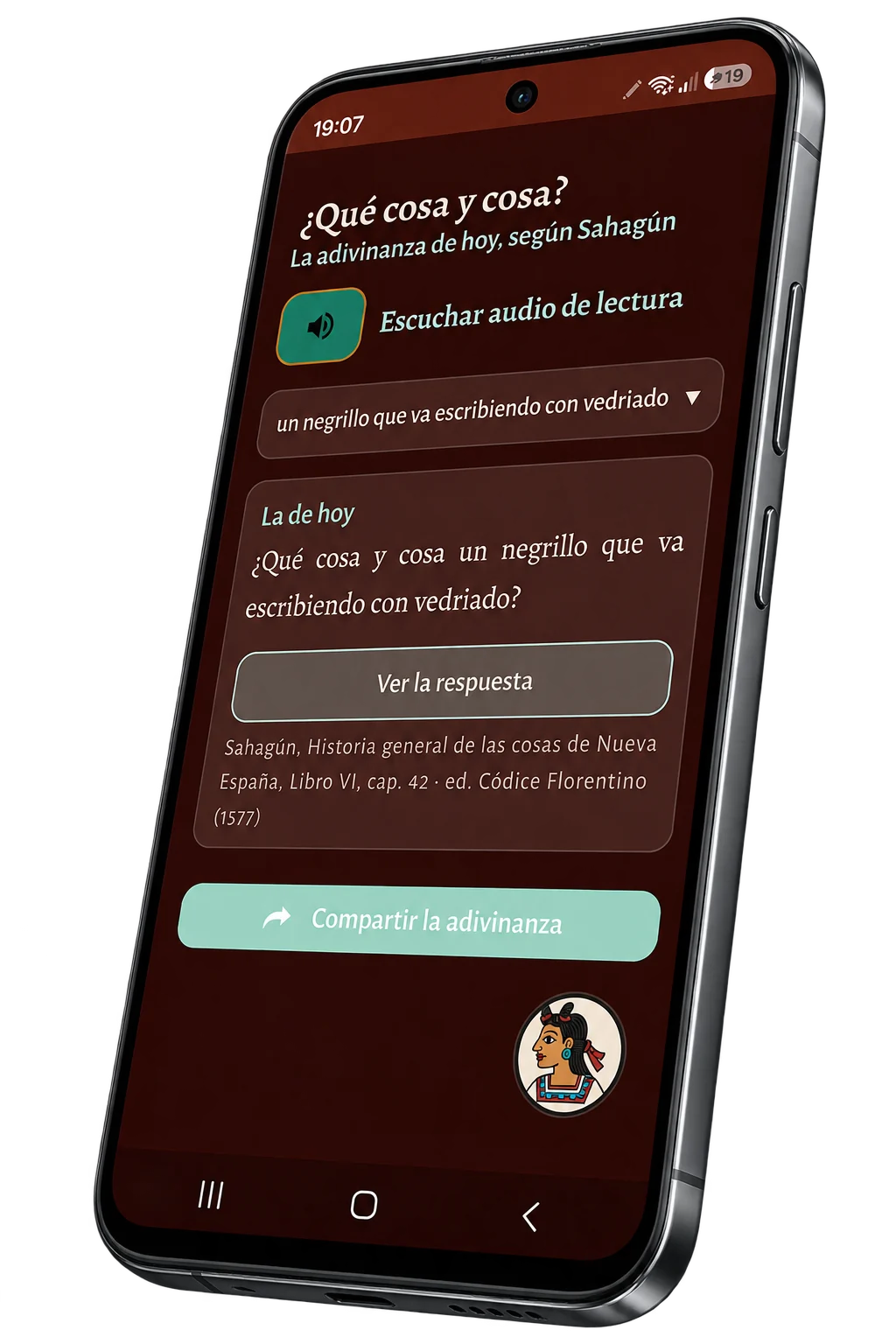
What thing and thing? The riddle of the day, as it was told in Tenochtitlan. Sahagún collected a whole set of them in Book VI, chapter 42, and there they are, with the answer hidden until you ask for it.
How it differs from a meditation app
What plays is not a recording. There is no catalogue of tracks someone chose. The piece is derived from the numbers of the day — the numeral, the sign, the trecena, the direction — and is synthesised on your phone with timbres measured on real Mexica instruments.
The same day always sounds the same. Your birthday has its piece and it does not change when you open it again. And two different days never sound alike: there is no twenty-minute loop you end up recognising.
And no connection is needed. The music is computed on the device. On a plane, in the hills, or with data off, it sounds the same.
No subscription
Listening to the day's piece for an hour is free forever, with no trial and no countdown, along with one huehuetlahtolli per veintena, the riddle, and the whole walk of the day.
The rest — the long timers, the three characters, Breathe, the Vigil and the twenty speeches — is a single payment, not a monthly fee. On installing, everything is open for twenty days.
There is no user account either, no email, no tracking and no advertising. That boundary is written into the app's code, in a file that declares what stays open no matter what.
What is Sahagún's and what is this app's
Worth saying precisely, because it is easily confused.
The texts are not ours. The huehuetlahtolli come from the Florentine Codex, Book VI, and the riddles from Book VI, chapter 42. They are sixteenth-century, they are in the public domain, and anyone can read them — in the facsimile, in the editions, online.
What this app adds is something else, and that is its own. Which one falls today: one speech per veintena and one riddle per day, tied to the count, so the one you hear was not chosen by you or by us — it is chosen by the day. And hearing them, with a voice composed on the device rather than recorded.
One speech per veintena and today's riddle never expire. The twenty complete speeches come with the full version.
Questions that reach this page
Does Mexica music help you sleep? It is used for that: the timer runs to sunrise and the «sueño» character is the slowest of the three. We do not claim it induces sleep or improves rest, because we have not measured that.
Does the Mexica calendar app work without internet? Yes. The music is synthesised on the phone, so no connection is needed for any of this.
Is Alma Mexica a subscription? No. On installing there are twenty full days, and after that a single payment unlocks the rest for good.
What is a huehuetlahtolli? A speech of the elders: what a father said to his son, or a ruler to his people. Sahagún collected a set of them in Book VI of the Florentine Codex, and those are the ones read here, cited by folio.
Which instruments is the music made with? Six Mexica ones: huehuetl, teponaztli, tlapitzalli, atecocolli, ayacachtli and cuechtli. Their timbres are measured on recordings, and each can be heard on its own.
Is it authentic Aztec music? No, and it is worth saying plainly: nobody knows how Mexica music sounded, because no notation survived. What is measured are the timbres of the instruments, not the melodies.
Are the elders' texts this app's own? No. They are from the Florentine Codex, Book VI, in the public domain, and anyone can read them. What this app adds is which one falls today — tied to the count — and hearing them read with a voice composed on the device.
How many huehuetlahtolli are free? One per veintena, and it never expires, along with today's riddle. The twenty complete speeches come with the full version.
Twenty full days on installing. What is on the web and what is in the app.
How to cite this page
Alma Mexica, «Xochicuícatl», The app. Revised 2026-09-17. https://almamexica.org/en/app/xochicuicatl/