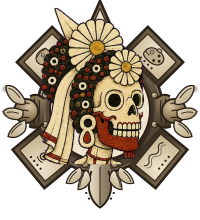
Chantico
She who dwells in the house
What it rules
The hearth fire — the warmth that holds a family together.
Why «energy» and not «god»
Because «god» translates badly. The Mexica did not separate the deity from the force it stands for in the way the European word does, and calling them gods imports an idea that is not theirs. «Energy» is not perfect either, but it does not carry that freight. It is a decision of this site, and it is declared as one.
The full entry is in Spanish, and here is why
What you have read above is this project's own summary of Chantico. The full entry — the part that rests on the sixteenth-century sources — has not been translated, and that is a decision rather than an omission.
We chose not to touch the primary text. Those sections quote Sahagún, Durán and the codices in their own words, often in sixteenth-century Castilian. A quotation carried across stops being a quotation: it loses the register, the ambiguity and the exact wording someone might want to check against a facsimile.
In Spanish the entry carries:
- El nombre
- Fuego interior, no solo llama
- Doméstica y guerrera a la vez
- De dónde viene su imagen
Read the full entry in the original Spanish → Nahuatl names and terms are identical in both versions.
The name
She was represented by the three stones that make the hearth — the place where the family gathers, where food is prepared and where the fire must never go out. She is the counterpart of Xiuhtecuhtli: if he is the cosmic, volcanic fire, Chantico is the small and near one, the fire that warms a house.
Her name translates as «in the house», and it must be understood as the fire of the house, the hearth fire.
And she has a story of her own: in the Legend of the Suns, Tata and Nene, the survivors of the flood, made fire with sticks to cook fish, in the year 1 Rabbit. A fire made without permission that restores the earth — which is why in the Classic period the New Fire was kindled in 1 Rabbit.
Inner fire, not only flame
Chantico did not govern only the physical hearth: she was tied to the «fire of the heart», the passions and each person's inner heat. She was also patron of jewellers, stone engravers and lapidaries — trades of precision, of sustained heat and of exact work.
Domestic and warlike at once
Chantico also had a martial aspect: she was shown with the sign atl-tlachinolli, «water and fire», the way war was named in Mexica iconography. That double nature — protector of the home and at the same time able to defend it — is not a contradiction: it is what a hearth is.
How to cite this page
Alma Mexica, «Chantico», The energies. Revised 2026-09-17. https://almamexica.org/en/energy/chantico/