The herbal
What the sixteenth-century sources record about plants
What this is
The plants the sixteenth-century sources record. Here you will not find what to take: you will find what a source said, with its folio, and what it does not say.
It is told the way a feast is told: to know what was done, not to do it.
Two of the four groups are here
Food plants — the ones that held daily life up: chia, nopal, maguey, epazote. And ritual plants — copal, pericón, tobacco, estafiate — the ones that accompany the feasts and are still in use.
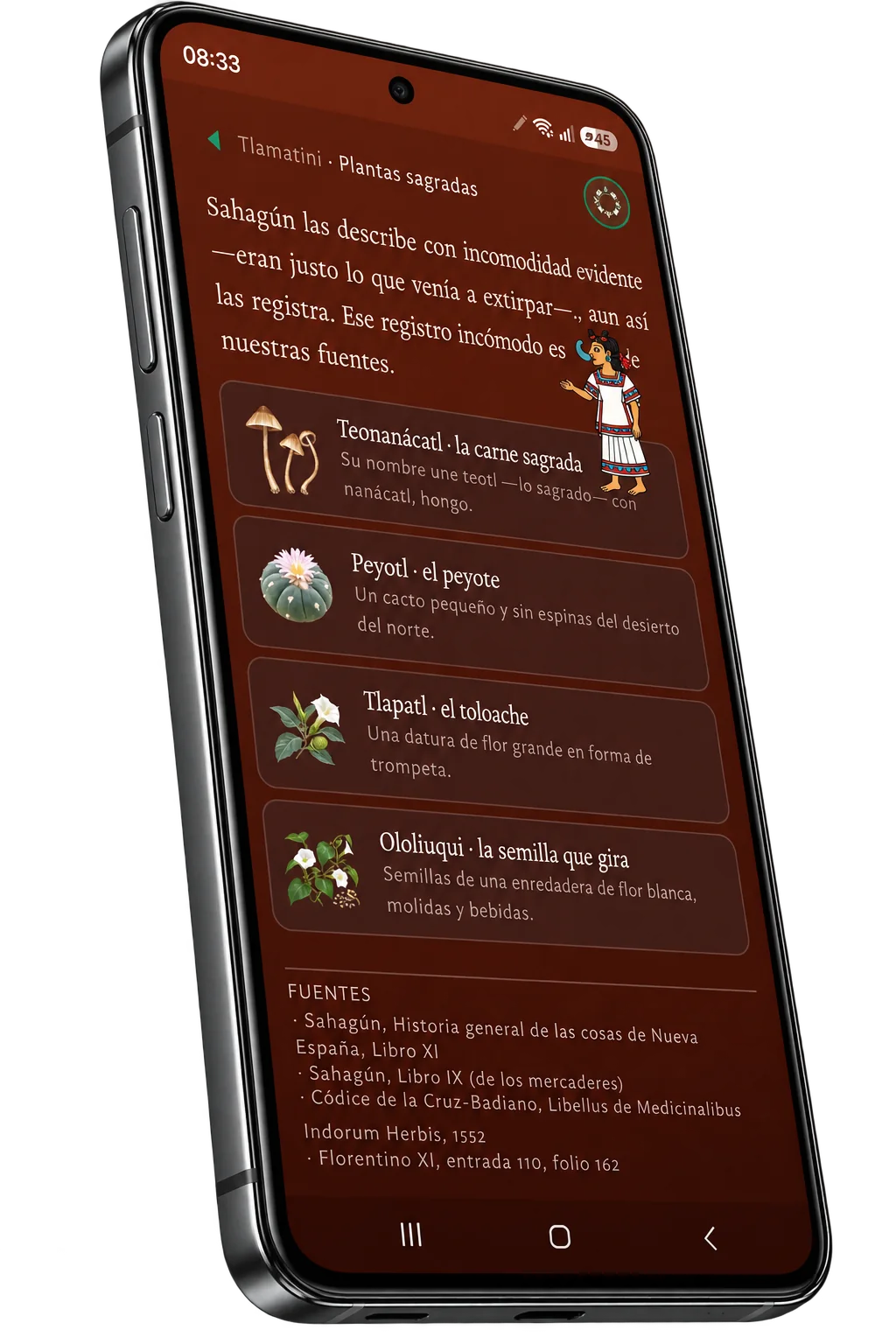
The other two are in the app: the medicinal ones and the sacred ones. The reason is not the price. Some entries can be read as a prescription, and the sacred ones are controlled substances, several of them toxic — a page carrying their names would draw whoever is looking for how to use them, not whoever is looking for what the source said.
The Badianus Codex
A Mexica herbal written by Mexica: Martín de la Cruz composed it and Juan Badiano translated it into Latin, at the College of Santa Cruz de Tlatelolco, in 1552.
It is one of the very few sources where the voice is from inside, and very few people know it exists.
How to cite this page
Alma Mexica, «The herbal», Alma Mexica. Revised 2026-09-17. https://almamexica.org/en/herbal/
Questions that reach this page
What is the Badianus Manuscript?
An Aztec herbal written by Aztecs in 1552: Martín de la Cruz composed it and Juan Badiano translated it into Latin, at the College of Santa Cruz de Tlatelolco. Its Latin title is Libellus de Medicinalibus Indorum Herbis, and it is one of the very few sixteenth-century sources where the voice is from inside.
What plants did the Aztecs use as medicine?
The sixteenth-century sources record dozens: tlalquequetzal for wounds, zoapatle in childbirth, cuauhchichic as a bitter. This site reports what Sahagún and the Badianus Manuscript say about them, not a recommendation for use: it is told the way a feast is told, to know what was done, not to do it.