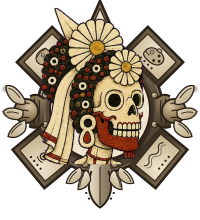
Tezcatlipoca
The smoking mirror
What it rules
The night sky, destiny and transformation.
Why «energy» and not «god»
Because «god» translates badly. The Mexica did not separate the deity from the force it stands for in the way the European word does, and calling them gods imports an idea that is not theirs. «Energy» is not perfect either, but it does not carry that freight. It is a decision of this site, and it is declared as one.
The full entry is in Spanish, and here is why
What you have read above is this project's own summary of Tezcatlipoca. The full entry — the part that rests on the sixteenth-century sources — has not been translated, and that is a decision rather than an omission.
We chose not to touch the primary text. Those sections quote Sahagún, Durán and the codices in their own words, often in sixteenth-century Castilian. A quotation carried across stops being a quotation: it loses the register, the ambiguity and the exact wording someone might want to check against a facsimile.
In Spanish the entry carries:
- El nombre
- Noche, destino y transformación
- La dualidad con Quetzalcóatl
- Dos símbolos: el espejo y el pie
- Dónde se le rendía culto
- Qué era un nahualli
- De dónde viene su imagen
Read the full entry in the original Spanish → Nahuatl names and terms are identical in both versions.
How to cite this page
Alma Mexica, «Tezcatlipoca», The energies. Revised 2026-09-17. https://almamexica.org/en/energy/tezcatlipoca/
The name
The full name points to the mirrors of polished obsidian with which this energy was shown: on the chest, in the headdress, or in place of one of his feet. Those mirrors were not ornament — they were held to have divinatory power.