The eagle and the serpent
What it covers
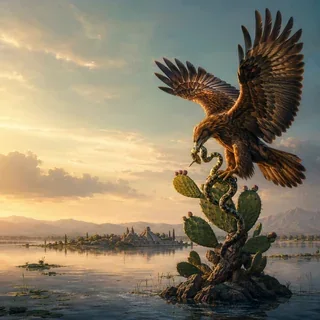
The sign that marked where Tenochtitlan was to be founded, and what the sources actually say about it.
The full entry is in Spanish, and here is why
What you have read above is this project's own summary of the eagle and the serpent. The full entry — the part that rests on the sixteenth-century sources — has not been translated, and that is a decision rather than an omission.
We chose not to touch the primary text. Those sections quote Sahagún, Durán and the codices in their own words, often in sixteenth-century Castilian. A quotation carried across stops being a quotation: it loses the register, the ambiguity and the exact wording someone might want to check against a facsimile.
In Spanish the entry carries:
- Una peregrinación de generaciones
- El nopal que nació de un corazón
- Una nota honesta sobre la imagen exacta
- Preguntas que llegan a esta página
Read the full entry in the original Spanish → Nahuatl names and terms are identical in both versions.
How to cite this page
Alma Mexica, «The eagle and the serpent», The legends. Revised 2026-09-17. https://almamexica.org/en/legend/el-aguila-y-la-serpiente/
Questions that reach this page
Why is there an eagle on the Mexican flag?
It comes from the sign that, in the Mexica sources, marked where Tenochtitlan was founded: an eagle perched on a prickly pear on an islet in Lake Texcoco. But the snake is not in the early sources: the Codex Mendoza shows the eagle on the cactus with nothing in its beak, and other colonial sources mention birds, not a serpent.
Does the eagle in the Aztec founding myth really hold a snake?
No. No document of the period describes the scene the way it is told today. The Codex Mendoza draws the eagle on the cactus with no snake, and other colonial sources have the eagle eating birds. That the detail was added later does not make the account invented: it makes it worth knowing where each part comes from.