Advice and remedies
What suits today, and what the sources give for hard days
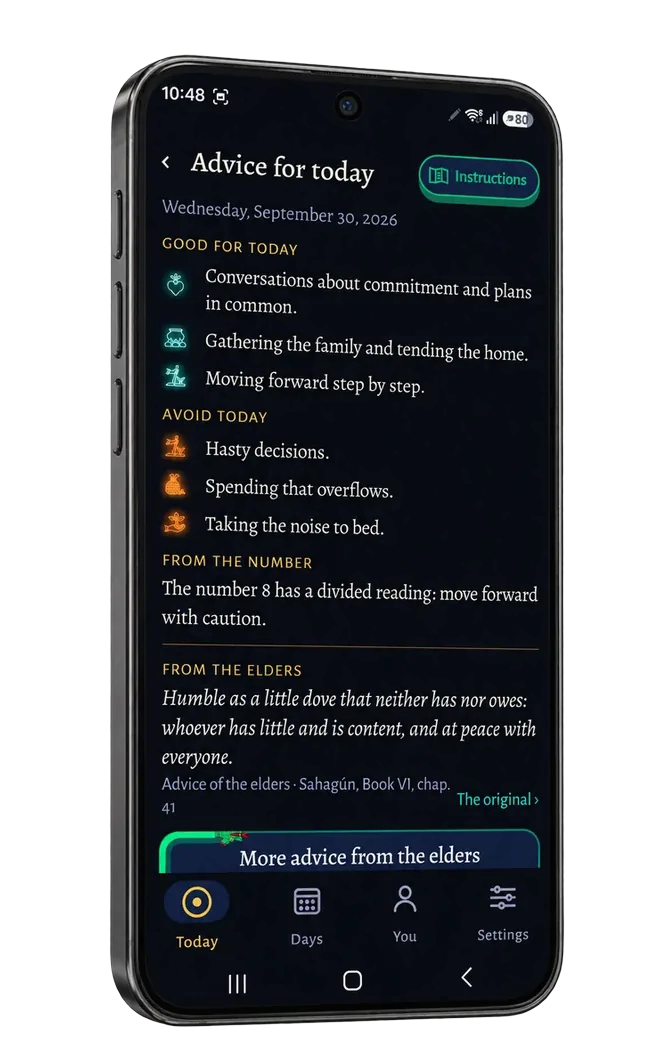
Each day brings what suits you and what is best avoided, in plain English. These are not general maxims: they come from what the sources attribute to that sign and that number.
And on hard days, a remedy. This is the most surprising thing in Book IV: the sixteenth-century text itself does not stop at saying a day is adverse — it gives you what to do. Baptising in the following house, penance, diligence. The tradition left no one at the mercy of their day.
Each piece of advice says where it comes from: Sahagún and the Florentine Codex, Durán, the codices of central Mexico, or the living tradition, stated as such and not confused with what is documented.
The old texts come in plain English, with the original beside them, in its sixteenth-century Spanish, for anyone who wants to check.
Questions that reach this page
What was done on the ill-fated days of the Aztec calendar?
They did not resign themselves. Book IV of Sahagún gives remedies for adverse days: baptising the child in the following house, doing penance, applying diligence. The day marked an inclination, not a sentence, and the text itself says what to do about it.
Is the app's advice made up?
No: each piece says where it comes from, and you can check. The ones that come from the living tradition — and there are some — are declared as such, not mixed in with what the sources document. That distinction is the rule of the whole project.